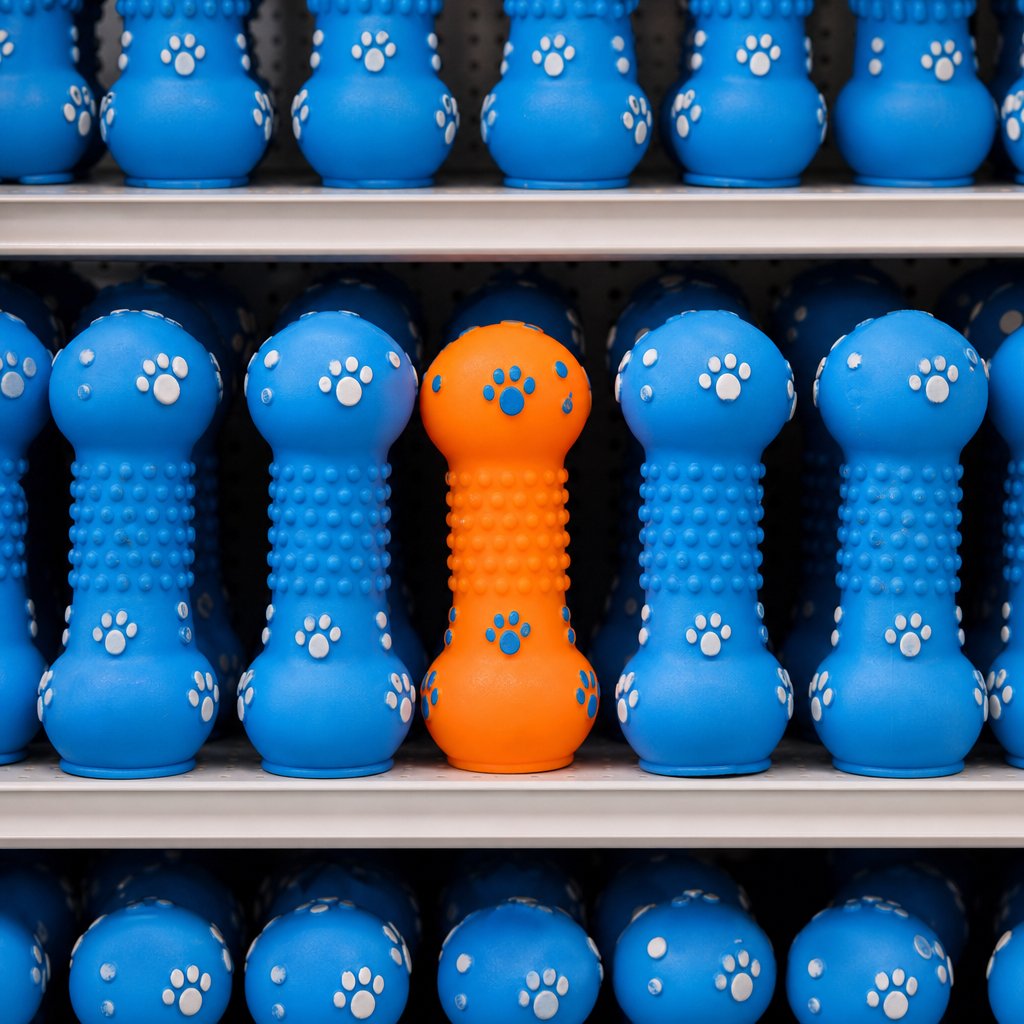
Key Takeaways
- Sameness is a supply-chain fact before it is a marketing problem: growth attracts entrants, entrants share molds, shared molds make clones.
- Five levers create real distance: material upgrades, scenario niches, bundle forms, packaging systems and service promises.
- Material is the highest-yield lever because buyers can feel it — odor, texture, rebound — and documents can prove it.
- Scenario niches are won with honest labels and curation, not new tooling.
- Run the five-step competitor teardown before spending anything; most gaps cost less than they look, and some cost nothing.
Scroll forty listings for squeaky dog toys and the carrots begin to blur: same shape, same squeaker, same three adjectives, same golden retriever holding the same pose. The sameness is not a failure of imagination. It is what happens when a market grows fast enough to attract entrants faster than it differentiates them — Grand View Research sized the pet toy market at USD 10.6 billion in 2025, growing at roughly ten percent a year toward 2033, with dog toys already over half the total and soft toys the fastest-growing slice. Growth like that is an open invitation, and most guests arrive carrying the same catalog.
The escape is not one big idea. It is choosing the right lever — of the five that actually move generic categories — and pulling it where your supply chain can genuinely support the claim. This article lists the levers, costs them honestly, and ends with a teardown method for finding the gap nobody has taken.
Why Generic Categories Stay Generic
Sameness begins in the mold room, not the marketing meeting. Proven tooling is cheap to reuse and expensive to change, so factories quote from catalogs and buyers ask for "that one, but cheaper." Each player along the chain optimizes locally: the factory reuses what runs, the brand lists what exists, the copywriter describes what arrived. The loop closes — same molds, same products, same claims — and price becomes the only axis left standing.
The loop also explains why most differentiation attempts fail: they happen after molding, where nothing physical is left to differentiate. Real distance requires changing a decision made before production — the compound, the target scenario, the pack, the promise. That is good news, because those decisions are exactly where a sourcing relationship has leverage.
Five Levers That Create Distance
Generic categories reward five specific levers. Each has a different price tag and builds a different depth of moat:
| Lever | Pet-toy example | Cost to adopt | Moat depth |
|---|---|---|---|
| Material upgrade | Low-odor virgin-compound TPR line; latex figures instead of thin vinyl | Moderate — compound and process change | Deep: copying needs the same documents and discipline |
| Scenario niche | Apartment-quiet fetch line; senior-dog soft collection | Low — labels and curation | Shallow to moderate |
| Bundle form | Life-stage kits; size-matched multi-dog sets | Low to moderate | Moderate |
| Packaging system | Color-blocked line identity recognizable at shelf distance | Moderate — packaging minimums | Moderate to deep |
| Service promise | Chew-tier honesty backed by batch test data; fast sampling | Low to moderate | Deep — purely operational |
The portfolio rule: pull one deep lever and one shallow one, executed fully, rather than five attempted halfway. Depth compounds; half-depth is decoration, and shoppers can smell decoration through the page.
Material Upgrades Buyers Can Feel
Material wins because it registers on senses before it registers on claims: the smell when the box opens, the give under a thumb, the rebound off a floor, the weight in a hand. A line built on virgin compounds for mouth-contact parts, a controlled low-odor process, and durometer tiers matched to dog sizes is describable in one sentence a buyer can verify on first touch — the material fundamentals are unpacked in our guide to what TPR actually is.
It is also the lever with the best paper trail. Colorants screened to EN 71-3 style migration methods, phthalate screening on plasticized parts, and positive reference to ASTM F2999 — the standard written for pet toys — turn the upgrade into documents a wholesale buyer can forward to their own compliance team. Describe the tests actually run; the honesty is part of the differentiation. Clones can copy a shape in a season, but batch-level consistency is an operational habit, not a file.

Scenario and Bundle Niches
The cheapest real differentiation is a sharper definition of who the toy is for. The same quiet-fetch ball becomes an apartment toy — honest about volume, honest about chase. The same soft plush becomes a senior-dog line when the label says gentle jaws and light weight instead of pretending toughness. Puppy teething kits, multi-dog household sets and breed-size-matched groupings all reuse existing tooling while changing who recognizes themselves on the page. Our guide to choosing toys by life stage maps the segments in detail.
The economics are asymmetric in your favor: curation and labels cost almost nothing, the sharper targeting lowers returns by aligning expectations, and bundles built on the same niche add a second purchase to the first. What scenario niches lack is depth of moat — a copyist can relabel within weeks — which is precisely why they pair well with the material lever above: niche for entry, material for defense.

Finding Your Gap: A Five-Step Teardown
Gaps are found with a table, a board and an afternoon:
- Pull the top forty listings in your category and log shape, material words, claims and price for each.
- Re-cluster by true material at datasheet level — compound, fabric, rope — not by the adjectives on the page.
- Harvest review themes for the top ten: what buyers praise, what returns and one-stars keep repeating.
- Cross the clusters with the complaints; empty quadrants where demand is loud are candidate gaps.
- Cost the two best gaps with your supplier — what changes in compound, packaging, minimums — then prototype one.
What the exercise usually reveals is that the gap is not a product nobody makes but a claim nobody can prove. That is the best kind: the material and service levers turn it into a defensible position, and the supply relationship decides how cheap the defense is. Our materials matrix exists precisely so that step five is a conversation with documents, not a guess.
Frequently Asked Questions
FAQ
Which differentiation lever is cheapest to start with?
Does differentiation always raise the unit cost?
How do I know a gap is real and not just empty?
Can factories copy a differentiated toy?
Found your gap and need a supplier who can prove it?
Send the concept — we reply with material options, the test plan behind each claim and FOB ranges for the differentiated spec.